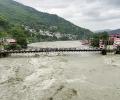
Incessant rains unleashed more death and destruction on Monday in parts of north India, with 37 people killed in landslides and other rain-related incidents in the last two days even as the Army and NDRF teams stepped in to intensify the relief and rescue operations.

The mean maximum temperature for the month of March was 28.2 degrees Celsius in 2020 and 2019. It was 32.8 degrees Celsius in 2018; 30.7 degrees Celsius in 2017 and 31.5 degrees Celsius in 2016, according to the India Meteorological Department data.

The Safdarjung Observatory, which provides representative data for the city, recorded a maximum temperature of 40.1 degrees Celsius, which was eight notches more than normal, said Kuldeep Srivastava, the head of the IMD's regional forecasting centre.

Timely onset of south-west monsoon is crucial for kharif (summer) crops.

Green think tank Centre for Science and Environment (CSE) said the ongoing smog episode is a public health emergency.

The cyclone is expected to make landfall on Thursday evening as a 'very severe cyclonic storm' with maximum wind speed reaching up to 150 kilometres per hour, the India Meteorological Department (IMD) said.

No lives were lost after cyclone Biparjoy made landfall. Preparations for Biparjoy were not only extensive, they were also telecast far and wide. Ahead of the cyclone's landfall, Shyam G Menon observes there was considerable publicity on how much the government was geared up to face the storm and its aftermath.

The epicenter of the quake was Sonitpur and the quake occurred at 7.51 am at a depth of 17 kilometres, it said.

Bharadwaj said it has not rained in Delhi in the last 3-4 days, yet still the water level in Yamuna reached 208.66 metres.

Tourism is badly affected. Entire apple orchards have been washed away. 2 million people are threatened with loss of livelihood.

'AI can be very useful for making analysis and especially making city-based local forecasts.'

A series of flash floods in Himachal Pradesh and the Union Territories of Jammu and Kashmir, and Ladakh killed at least 16 people on Wednesday and damaged several residential houses, standing crops and a mini power plant, officials said.

Three national highways in Kutch, Navsari and Dang districts were blocked due to damage caused by rains. Fifty one state highways and over 400 panchayat roads have also been damaged, state Disaster Management Minister Rajendra Trivedi told reporters.
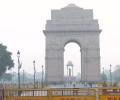
According to forecasting agencies, the city is set to record its best air quality for the day after Diwali since 2015 on Tuesday.

Super cyclone Mocha made landfall along the Myanmar-Bangladesh coasts on Sunday after intensifying into the equivalent of a category-five storm, a senior Met official said.

The four, including two women, were seated in S-8 and S-9 coaches, which are non-AC, and other passengers claimed that they died due to excessive heat.

No improvement in the air quality in Delhi-NCR is expected for another three days, authorities said on Monday, as the Supreme Court directed the Centre to call an emergency meeting to decide on measures like stopping non-essential constructions, transport and power plants by Tuesday evening.

Palodhi in Rajasthan simmered at 51 degree Celsius and the maximum in Ahmedabad shattered a century-old record.

Cyclone Biparjoy has left a trail of destruction in Gujarat's Kutch and Saurashtra regions as some 1,000 villages are still without power with hundreds of electric poles getting damaged, while several coastal villages were flooded due to heavy rains and incoming seawater, officials said on Friday, a day after the storm made landfall.

Heavy downpour continued in various parts of Gujarat on Tuesday and six people died in rain-related incidents in the last 24 hours, raising the toll to 69 since June 1, officials said.

The mercury breached the 46-degree Celsius mark in several places such as Allahabad (46.8 degrees Celsius) and Jhansi (46.2 degrees Celsius) in Uttar Pradesh; Sports Complex (46.4 degrees Celsius) in Delhi; Ganganagar (46.4 degrees Celsius) in Rajasthan; Nowgong (46.2 degrees Celsius) in Madhya Pradesh; and Maharashtra's Chandrapur (46.4 degrees Celsius).
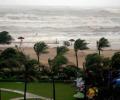
Under its impact, rains will start on Sunday night and gradually increase on Monday in the northern districts of Chennai, Tiruvallur and Kancheepuram, S Balachandran, Director, Area Cyclone Warning Centre, said.

According to the Graded Response Action Plan (GRAP), the air quality is considered to be in the emergency category if the PM2.5 and PM10 levels continue to be above 300 micrograms per cubic metre and 500 micrograms per cubic metre respectively for 48 hours or more.

The overall Air Quality Index (AQI) of Delhi stood at 398 at 11 am, worsening from 357 at 4 pm on Friday. It was 354 on Thursday, 271 on Wednesday, 302 on Tuesday and 312 on Monday (Diwali).

The Chinese capital Beijing was shrouded in thick brown dust on Monday morning as a result of heavy winds blowing in from Inner Mongolia and other parts of northwestern China.

Chief Minister Vijay Rupani said people living in the coastal belt would be shifted to safer places.

The storm is India's strongest tropical cyclone to make landfall in 20 years.

The city has been witnessing heavy rains since Tuesday night, resulting in water logging in many areas.

Experts said unfavourable meteorological conditions -- calm winds and low temperatures -- and smoke from farm fires in neighbouring states led to a dense layer of haze as the air quality index entered the "severe" zone.

Experts said while meteorological conditions were "moderately" favourable for dispersion of pollutants, a "very high" number of farm fires in Punjab was the primary reason for "severe" air quality.

The very severe cyclonic storm Tauktae is likely to intensify during the next 24 hours and reach the Gujarat coast on Monday evening, the India Meteorological Department (IMD) said.

The cover provided under the Centre's Pradhan Mantri Suraksha Bima Yojana, which is a vital safety net for them, ended almost a year back on May 31, 2020. Ever since, there hasn't been much progress on the higher insurance coverage of Rs 5 lakh promised under the newly launched Pradhan Mantri Matsya Sampada Yojana, reports Sanjeeb Mukherjee.
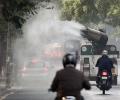
A special bench headed by Chief Justice N V Ramana, in an interim order uploaded Wednesday night, also directed the Commission for Air Quality Management in the NCR and Adjoining Areas to 'commission a scientific study of air quality based on available data of previous years bearing upon recorded levels of air pollution'.

Cyclone Biparjoy made landfall near Jakhau Port in Gujarat on Thursday evening with a wind speed of 115-125 kmph gusting to 140 kmph as heavy rains lashed the coastal region, where several areas plunged into darkness due to power cuts and a large number of trees, electric poles and hoardings got uprooted.

'Already, the temperature has touched 39 degrees in some parts of Gujarat and now we are in the last week of February.' 'We need to activate the heat action plan from March 1.'
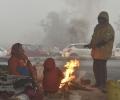
The mean minimum temperature for November was 9.6 degree Celsius in 1938; nine degree Celsius in 1931 and 8.9 degree Celsius in 1930, according to IMD data. Normally, the mean minimum temperature for the month of November is 12.9 degree Celsius.

As the low-pressure area in the south-eastern Arabian Sea intensified into a severe depression on Friday, heavy rains lashed many parts of Kerala and huge tidal waves started hitting low-lying coastal areas.

A record 119.3 mm rainfall pounded Delhi under the impact of cyclonic storm Tauktae and a western disturbance in 24 hours ending 8:30 am on Thursday, breaking all the previous records for May, the IMD said on Thursday.

On Wednesday, the top court observed that the Centre's talks with the protesting farmers have 'not worked apparently' and were bound to fail, and said it will form a committee having representatives of both the sides, but the agitating leaders dismissed it as no solution.

There were no reports of loss of property or life.
